

Soft Matter Physics
"Soft matter" is a convenient term for materials that are easily deformed by thermal fluctuations and external forces. In short, it refers to ‘all things squishy’! Everyday examples include paint, blood, milk, spreads and ice cream. Soft materials share several characteristic features, e.g. that their building blocks are intermediate in size between atoms and grains, and this is crucial to understanding their behaviour. In the Edinburgh Soft Matter Physics group, we use experiments, computer simulations, and theoretical calculations to understand colloidal and granular model systems for phenomena ranging from jamming to bacterial colonies and to rationally design novel soft materials for use in applications ranging from foods to energy materials.
Overview
The experimental research in our group has two directions: ‘Soft Matter’, a sub-discipline of physics concerned with the study of colloidal suspensions, surfactants and polymers, and Active Matter (see also here) the active or life counterparts of soft matter, such as bacterial suspensions and biological polymers. A large number of the materials studied have industrial applications and the group has a dedicated team who undertake industrially linked research.
Soft matter displays many fascinating properties. One example is shown above, where suspensions of Perspex spheres that act as hard particles (~1 micron diameter), self assemble into ‘colloidal crystals’ at high densities. The right-hand-side movie, taken with confocal microscopy, shows the crystal growth process, while the iridescence in the main picture is due to individual colloidal crystallites Bragg-scattering incident white light. Soft matter also shows interesting mechanical behaviour. A well known ‘kitchen’ example is ‘shear thickening’ - a concentrated corn starch solution gets harder to stir the harder it is stirred. Significantly, biology is almost entirely made up of ‘living soft matter’ – globular proteins are colloids, DNA is a stiff polymer, and the lipids forming cell membranes are essentially surfactants.
Soft matter has been studied by chemists, chemical engineers and biologists for many years. It is increasingly clear, however, that these systems show generic properties independent of chemical details. For example, all polymers share certain properties simply because they are long strings of balls performing Brownian motion. This is the central reason why physicists are getting interested. Moreover, studying the generic properties of soft matter can give fresh insights into a broad range of fundamental questions that cut across the whole of condensed matter physics, e.g. concerning the nature of disordered solids.
Many experimental projects (mostly done in our interdisciplinary labs for physicists, physical chemists and biologists) are closely related to projects in theory and simulation in our group.
Research interests
Much of our research is funded by successive EPSRC programme grants, the current one running from December 2011 for 6 years. This flexible funding source gives significant scope for exploration of new topics and the exploitation of unexpected opportunities arising from on-going research, and for postdoctoral researchers to work on multiple projects. The main directions of our research are:
Rheophysics of soft matter
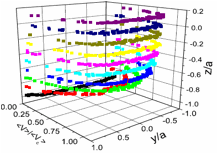
What physical mechanisms govern the yielding and flow of dense colloids, gels and emulsions and how are these related to the ‘dynamical arrest’ or jamming in these systems without flow? We study these problems via confocal microscopy of the flow (particle tracking and velocimetry) with simultaneous rheological measurement. These experiments give important new insights in this field, sometimes overthrowing accepted ideas and results in concentrated colloid rheology. For example, the flow of a concentrated hard sphere suspension in a rectangular channel (flow profile shown in figure) is not like that of a ‘yield stress fluid’, but behaves instead more like dry grains (click here for the paper). For more details on the various projects, see below.
Physics of barriers in soft matter and biology
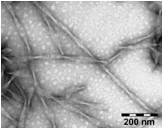
The ‘aging’ of concentrated metastable states in colloids (‘glasses’), the switching between different phenotypes in bacteria, and the nucleation of growth of fibrillar aggregates in certain proteins (see picture, click here and here for related papers) share a common feature – all three processes involve crossing energy (or free energy) barriers. Experimental work in all three areas will be complemented by novel simulations and analytic theory. We believe generic features will emerge despite apparent dramatic differences between these experimental systems.
New soft materials
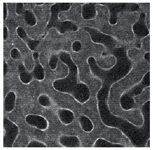
An emerging research focus is the study of colloidal particles dispersed in complex solvents, in particular various liquid crystals and phase-separating binary fluids. Often, new soft materials result. Because of the presence of an ‘intermediate length scale’ between colloids and the bulk, the properties of these materials can often be tuned by altering kinetic pathways during their preparation. For example, the picture shows what happens when a binary liquid mixture phase separates under the ‘spinodal’ mechanism in the presence of particles that wets the two phases equally – a bicontinuous jammed emulsion (bijel) is formed (see the paper announcing its discovery and a more recent one on the effect of the particle size). Work is ongoing to develop bijels and bijel-derived materials for a number of applications, including filtration, separation, and electrodes and electrolytes. Additionally, our focus on kinetic pathways has led to collaborations with a number of industrial partners to explore the influence of processing routes on their products. We are also interested in gels formed by fibrillar protein aggregates (see also under barrier crossing). While in vivo these are associated various neurodegenerative diseases, our interest is more in using these as structural elements in building new soft materials.
Physics of cellular motion
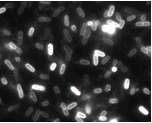
The current experimental focus here is on the motility of bacteria (see picture for E. coli cells with their flagella) in complex polymer media – concentrated polymer solutions as well as porous polymer gels (including agar, a standard microbiological culture medium). We are interested in how the polymer affects the motility of single cells, as well as how various kinds of collective motion may emerge, either ‘on its own’, or under the influence of external fields (such as gravity, or gradients in nutrients, etc.). Bacterial motility in confined geometries, such as inside microfluidics devices, is also of interest. This new area emerged partly because we started thinking about bacteria as colloids – they certainly fit into the colloidal domain in terms of size, with their locomotive ability adding extra features.
Physics of bacterial populations
Courtesy of Diarmuid Lloyd.
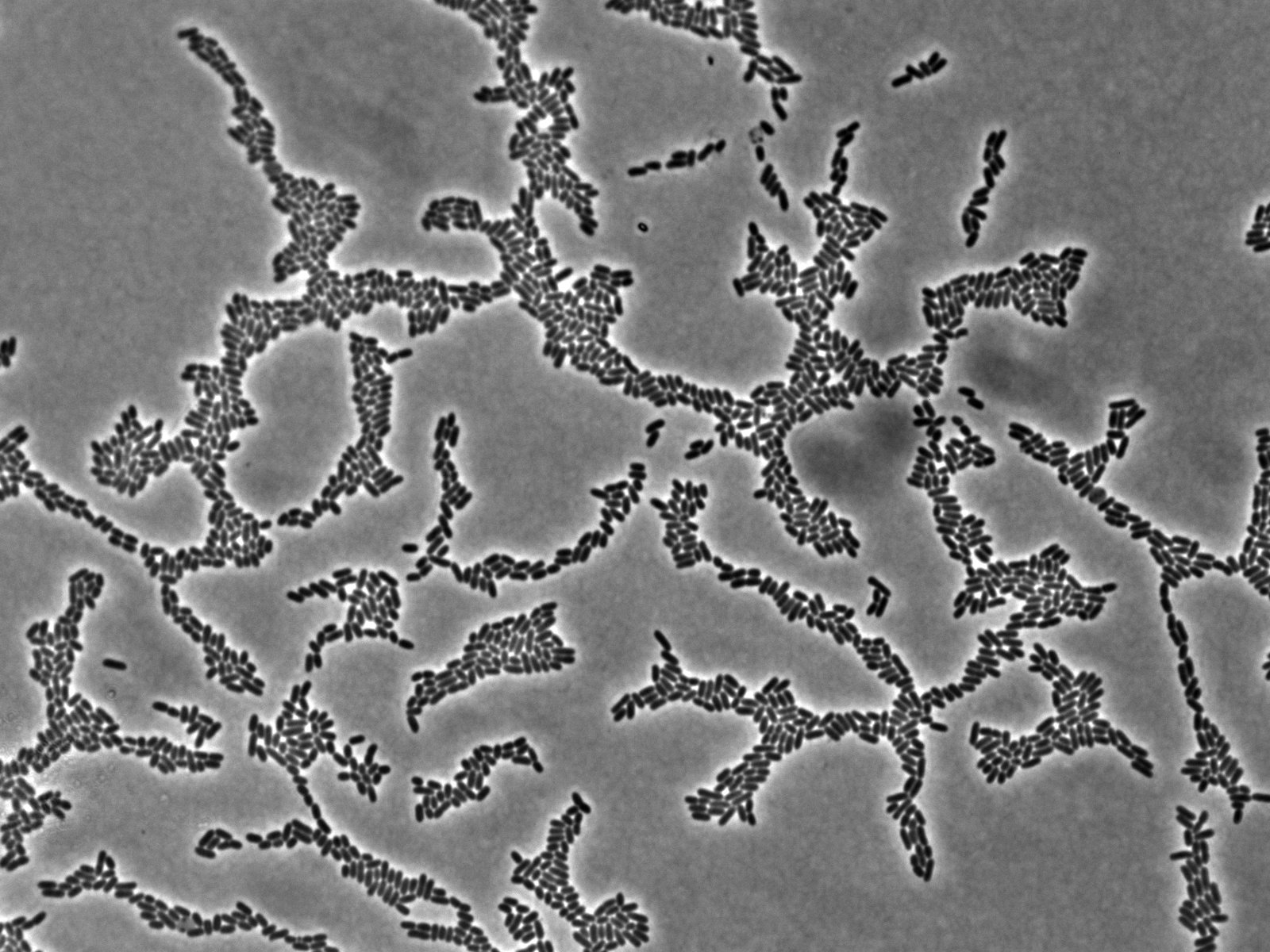
We are interested in the soft matter and statistical physics of bacterial populations. In particular, we are investigating how bacteria self-assemble to form biofilm communities on surfaces, how they aggregate together in suspension, how they respond to antibiotic treatment and how they interact with each other metabolically in complex and changing environments.
For further information, see Physics of Living Matter.
PhD project opportunities in Soft Matter Physics
- Active Self-Assembly of Colloidal Structures
- Bringing Order to a ‘Zoo’ of Colloidal Gels
- Controlling bacteria aggregation for environmental remediation and biotechnological applications
- Controlling the microbial generation of nitrous oxide in wastewater treatment; a pathway to reduce greenhouse gas emissions
- Developing tractable model systems for filamentous bacteria in wastewater treatment
- How do Dense Suspensions Flow?
- Interfacial properties in complex particulate formulations
- Lava to chocolate: the flow of solidifying liquids
- Locomotion in Granular Materials
- Moving and growing among entanglements: the role of DNA in the physics of bacterial swimming and aggregation
- The physics of active colloids
- Theory and Simulation of Microbial Swimmers and Subcellular Liquid Crystals
- Topologically Active Polymers (Experimental and/or Computational)
People in Soft Matter Physics
Telephone numbers in the list below are shown as UK numbers. Callers from outside the UK should remove the leading zero and use the UK country code (+44).
| Name | Position | Contact details | Location | Photo |
|---|---|---|---|---|
| Academic staff | ||||
| Jochen Arlt | Senior Lecturer | j.arlt [at] ed.ac.uk | JCMB 2601 |  |
| Aidan Brown | Lecturer | Aidan.Brown [at] ed.ac.uk | JCMB 2616 |  |
| Paul Clegg | Professor | paul.clegg [at] ed.ac.uk | JCMB 2614 |  |
| Jean-Christophe Denis | Lecturer & Public Engagement Officer | J.C.Denis [at] ed.ac.uk | JCMB 2905 |  |
| Alex Lips | Honorary Professor | Alex.Lips [at] ed.ac.uk | JCMB | |
| Cait MacPhee | Professor | cait.macphee [at] ed.ac.uk | JCMB 2613 |  |
| Davide Marenduzzo | Personal Chair in Computational Biophysics | Davide.Marenduzzo [at] ed.ac.uk | JCMB 2506 |  |
| Gavin Melaugh | Chancellors Fellow | G.Melaugh [at] ed.ac.uk | JCMB 1506 | |
| Alexander Morozov | Professor | Alexander.Morozov [at] ed.ac.uk | JCMB 2507 |  |
| Wilson Poon | Emeritus Professor | W.Poon [at] ed.ac.uk | JCMB 2617 |  |
| Ciprian Pruteanu | Lecturer in Extreme Conditions Physics | cip.pruteanu [at] ed.ac.uk | JCMB 1608 |  |
| John Royer | Chancellor's Fellow | John.Royer [at] ed.ac.uk | JCMB 2610 |  |
| Tyler Shendruk | Reader in Theoretical/Computational Condensed Matter Physics | t.shendruk [at] ed.ac.uk | JCMB 2422 | |
| Job Thijssen | Reader | j.h.j.thijssen [at] ed.ac.uk | JCMB 2421 |  |
| Simon Titmuss | Reader | Simon.Titmuss [at] ed.ac.uk | JCMB 2504 |  |
| Research staff | ||||
| David Fairhurst | Reader | david.fairhurst [at] ed.ac.uk | JCMB 1612 | |
| Andreia Fonseca da Silva | Impact Acceleration Associate | Andreia.Silva [at] ed.ac.uk | JCMB 1509 |  |
| Daniel Hodgson | Executive Director Edinburgh Complex Fluids Partnership | Daniel.Hodgson [at] ed.ac.uk | JCMB 2621 |  |
| Rowland Raymond Kao | Personal Chair | Rowland.Kao [at] ed.ac.uk | Roslin Institute RI1.118 |  |
| Davide Michieletto | Royal Society Research Fellow | Davide.Michieletto [at] ed.ac.uk | JCMB 1505 |  |
| Ryan Morris | PDRA | ryan.morris [at] ed.ac.uk | JCMB 1601 | |
| Giuseppe Negro | Lecturer in Theoretical/Computational Biophysics | giuseppe.negro [at] ed.ac.uk | JCMB 1611 | |
| James Richards | Research Fellow | james.a.richards [at] ed.ac.uk | JCMB 1601 | |
| Andrew Schofield | PDRA | A.B.Schofield [at] ed.ac.uk | JCMB 2203 |  |
| Jana Schwarz-Linek | Senior Researcher | Jana.Schwarz-Linek [at] ed.ac.uk | JCMB 2609 |  |
| Tiffany Wood | Senior Knowledge Transfer Fellow | tiffany.wood [at] ed.ac.uk | JCMB 2611 |  |
| Research postgraduates | ||||
| Mais Alkhazaleh | Postgraduate Student | M.Alkhazaleh [at] sms.ed.ac.uk | JCMB | |
| Mariam Arif | Postgraduate Student | mariam.arif [at] ed.ac.uk | JCMB 2618 | |
| Sneha Biswas | Postgraduate Student | S.Biswas-9 [at] sms.ed.ac.uk | JCMB | |
| Holly Bridge | Postgraduate Student | H.Bridge-1 [at] sms.ed.ac.uk | JCMB 1613 | |
| Robin Burton | Postgraduate Student | robin.burton [at] ed.ac.uk | JCMB 2510 | |
| Nikki Fredriksz | Postgraduate Student | N.A.Fredriksz [at] ed.ac.uk | JCMB 3311 | |
| Ludovico Journo | Postgraduate Student | L.Journo [at] sms.ed.ac.uk | JCMB | |
| Harry McGill | Postgraduate Student | H.McGill [at] sms.ed.ac.uk | JCMB 2510 | |
| Auro Varat Patnaik | Postgraduate Student | Auro.Patnaik [at] ed.ac.uk | JCMB 1511 | |
| Rohan Singh | Visiting Postgraduate Student | R.Singh-13 [at] sms.ed.ac.uk | JCMB | |