
Neutrino experiment finds no evidence for a sterile neutrino
Scientists on the MicroBooNE experiment are closing the door on one explanation for a neutrino mystery that has plagued them for decades.
Latest results
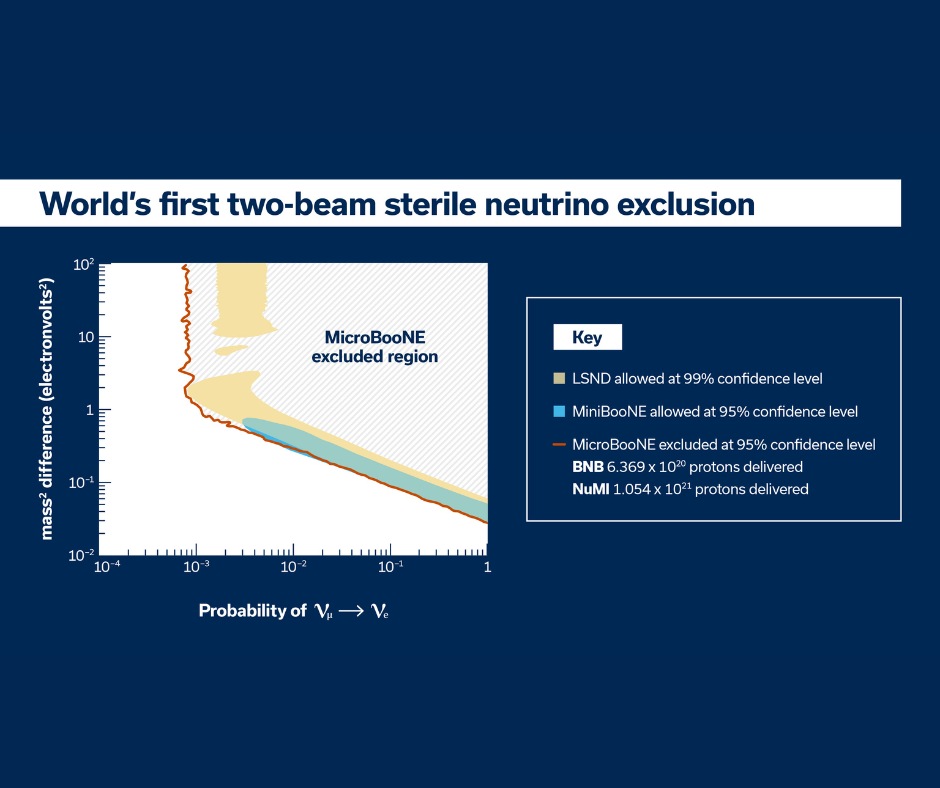
An international collaboration of scientists working on the MicroBooNE experiment announced that they have found no evidence for a fourth type of neutrino.
Earlier physics experiments saw neutrinos behaving in a way inconsistent with the Standard Model of particle physics. Theorists have suggested that a sterile neutrino could explain those anomalies.
However, with this new result, MicroBooNE has been able to rule out a single sterile neutrino explanation with 95% certainty.
The Standard Model & Neutrinos
The Standard Model is the best theory scientists have for explaining how the universe works. However, it is incomplete as it doesn’t account for dark matter, dark energy or gravity.
Physicists are therefore on the hunt for new physics that may shed light on some of the biggest mysteries in the universe, and part of this search leads them to study neutrinos.
According to the Standard Model there are three types, or flavours, of neutrino: muon, electron and tau. A number of mysteries surround these subatomic particles, and scientists observed unexpected behaviour that led them to consider the possibility of a sterile neutrino.
Edinburgh involvement
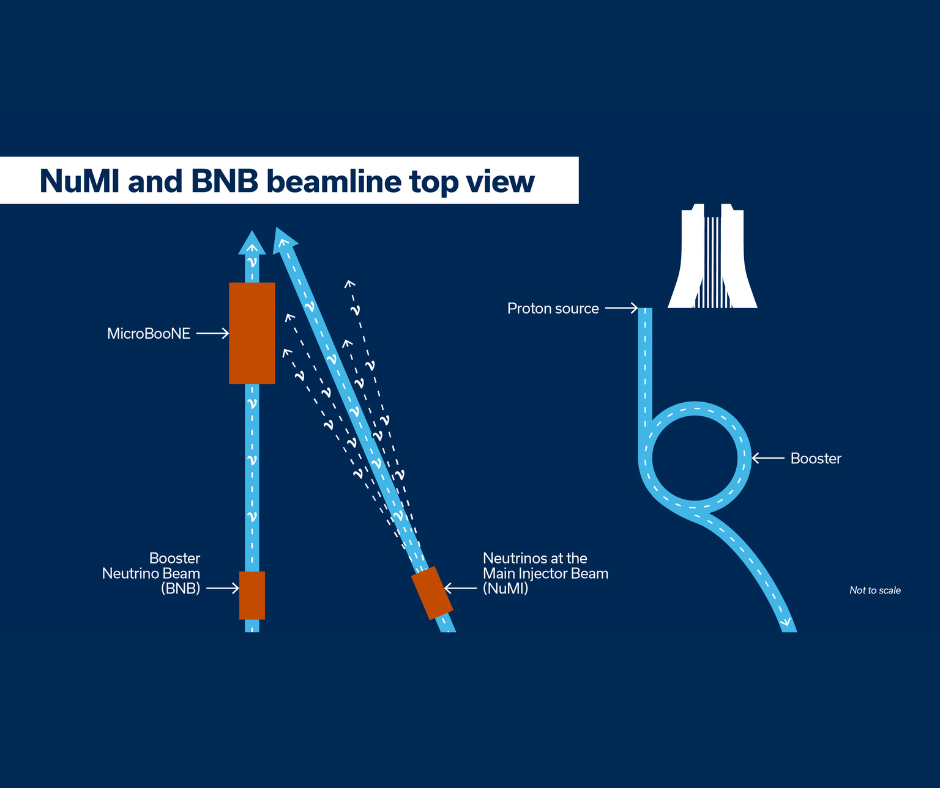
Researchers at the University of Edinburgh’s School of Physics and Astronomy have led the development of using the NuMI (Neutrinos at the Main Injector) beam for neutrino measurements, specifically the first measurements of electron-neutrino interactions on argon.
Edinburgh scientists have also led the major effort to process the data and simulations used to obtain these most recent results. Currently, the group is working on novel methods of identifying neutrinos from anti-neutrinos using their topologies, and is also working on the next generation measurements with the recently turned on Short-Baseline Near Detector (SBND) experiment.
What is MicroBooNE?
MicroBooNE is the first large liquid-argon time projection chamber to acquire a high-statistics sample of neutrino interactions. MicroBooNE’s cutting-edge technology can record incredibly precise 3D images of neutrino events, providing detailed information about how these elusive particles interact.
MicroBooNE is one of three experiments hosted by the Fermi National Accelerator Laboratory short-baseline (or short-distance) neutrino program.
The MicroBooNE is managed by the U.S. Department of Energy’sFermi National Accelerator Laboratory and the collaboration consists of 193 scientists from 40 institutions, including national labs and universities from six countries.
This latest research was published in Nature.
Image gallery