
The two phases of hot methane
High-pressure experiments reveal two distinct methane phase diagrams and revised melting conditions.
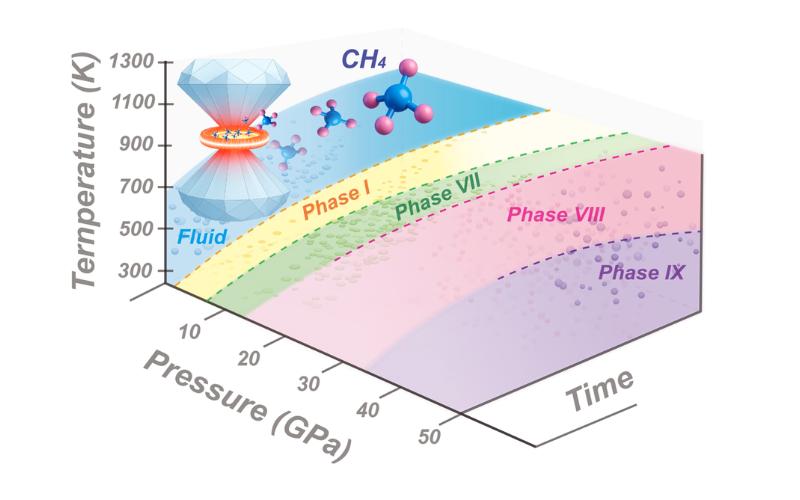
Methane is a deceptively simple molecule and the main constituent of natural gas found within Earth. As such, methane’s behaviour has multi-faceted importance for the fundamental sciences. A gas at ambient conditions, methane transforms to a fluid before crystallizing under pressure. The arrangement of molecules that constitutes the crystalline phase depends on both pressure and temperature, thus a 'phase diagram' can be drawn, mapping out the conditions under which each phase forms.
By conducting dozens of in situ high-pressure and high-temperature Raman spectroscopy experiments, the team at the School of Physics and Astronomy conducted a systematic exploration of the phase diagram, resolving inconsistencies in earlier studies. The experiments yielded two distinct phase diagrams, one that demonstrates phase transformations dominated by kinetics and the other presenting equilibrium states usually reached with time. Furthermore, the study demonstrated that the melting conditions at high pressure are vastly different from those previously reported. These discoveries provide new insights into chemical processes potentially occurring within planetary interiors.
The findings can be found in a paper published in Physical Review Letters by PhD student Mengnan Wang along with colleagues from the School’s Institute for Condensed Matter and Complex Systems. The work was supported by the UKRI Future Leaders Fellowship Mrc-Mr/T043733/1, planetary original diagnostic by Raman spectroscopy, the European Research Council (ERC) under the European Union’s Horizon 2020 research and innovation program (Grant Agreement no. 948895, MetElOne).
Dr Mengnan Wang said:
The high pressure studies of methane require a lot of patience and attention – we were waiting for days and sometimes for months to reach the equilibrium state, and we found out that some of the inconsistencies in the earlier melting data could be attributed to photochemical dissociation and/or a reaction induced by high-intensity light sources, a fact which was often missed in the earlier studies.
Image gallery