

The Beginning of a Colloidal Solid and the End of a Colloidal Solid
The Beginning of a Colloidal Solid and the End of a Colloidal Solid
- Event time: 4:00pm until 5:00pm
- Event date: 19th October 2026
- Speaker: Prof Paddy Royall (ESPCI Paris)
- Location: James Clerk Maxwell Building (JCMB) 2511 James Clerk Maxwell Building Peter Guthrie Tait Road Edinburgh EH9 3FD GB
Event details
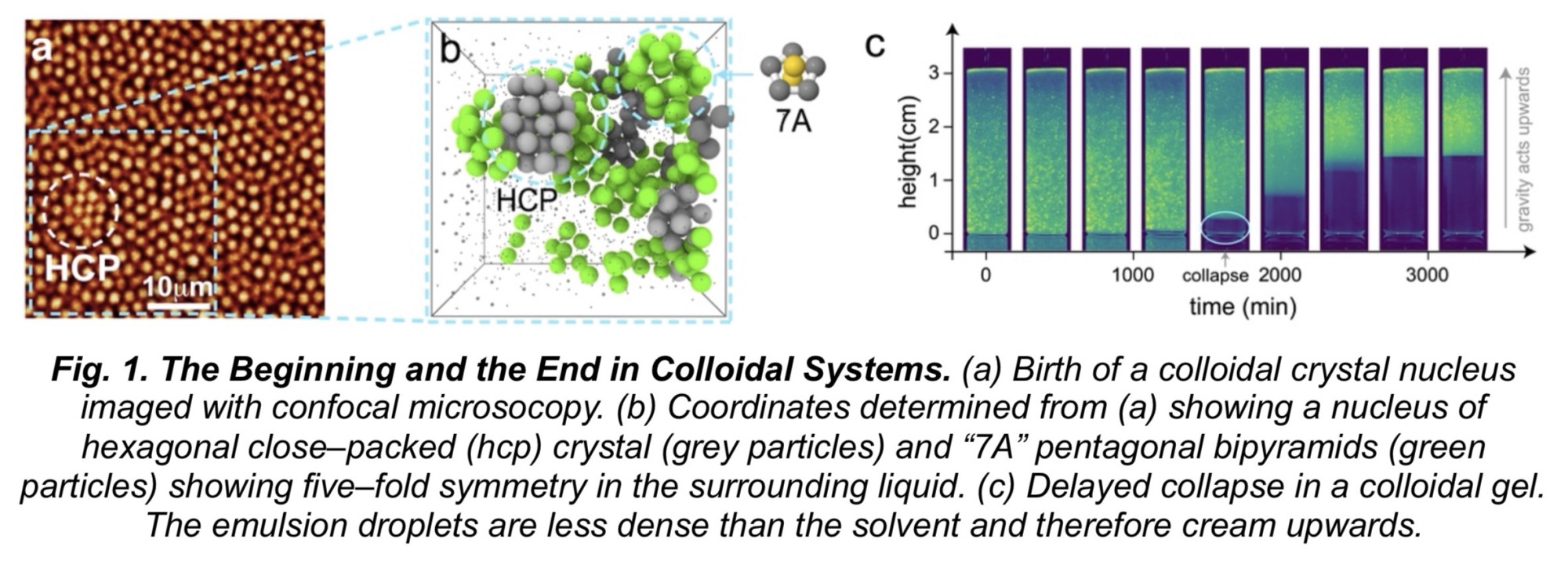
This talk deals with the beginning of a colloidal crystal, and the end of a colloidal gel. Crystallisation is among the most familiar physical phenomena of everyday life. One would imagine that it has been long understood. And yet there remain many basic unanswered questions, not least what is the rate of nucleation? In such general problems, model systems play a crucial role, as a benchmark of theory and computer simulation. Alas, the most studied material, colloidal hard spheres, exhibits a wild disagreement between experiment and numerical prediction of 20 orders of magnitude, which has been dubbed “the second-largest discrepancy in physics” [1]. Since the relevant experimental work was carried out in the last millennium, we expect that developments, such as particle-resolved studies may shed light on this phenomenon (Fig. 1a,b). With careful matching of state point between experiments and simulation, we do find agreement for the energy barriers to form pre-critical nuclei [2].
Colloidal gels are far-from equilibrium. As they age, gels stiffen due to coarsening of the network [3,4]. Remarkably, after a period of increasing strength, with no visible macroscopic change, gels undergo delayed catastrophic gravitational collapse (Fig. 1c). To understand yielding in gels, we have developed an experimental system to determine forces between particles, which reveals the local stress tensor [5]. But why does macroscopic delayed collapse occur? To answer this, we have developed a new technique to address this needle-in-haystack problem: multiscale confocal microscopy. Here we image an entire bulk sample with microscopic resolution which reveals the mechanism of this mysterious phenomenon [3].
[1] Royall CP et al, “Colloidal Hard Spheres: Triumphs, Challenges and Mysteries”, Rev. Mod. Phys. 96 045003 (2024).
[2] Kürten L, Castagnède A, Smallenburg F, Royall CP, “Narrowing down the cause of the hard-sphere nucleation discrepancy: The free energy of precritical nuclei is consistent with predictions”, Science Advances 12 eaec8906 (2026).
[3] Cheng R, et al. “Observing the mechanism of delayed collapse in colloidal gels: Yielding while becoming stronger”, Proc. Nat. Acad. Sci. 123 (20) (2026).
[4] H Bhaumik, JE Hallett, TB Liverpool, RL Jack and CP Royall, “Cyclically sheared colloidal gels: structural change and delayed failure time”, Soft Matter 21 8555-8568 (2025).
[5] J Dong, F Turci, RL Jack, MA Faers and CP Royall “Direct Imaging of Contacts and Forces in Colloidal Gels” J. Chem. Phys. 156 214907 (2022).
Further information
About Condensed Matter seminars
This is a weekly series of informal talks given primarily by members of the institute of condensed matter and complex systems, but is also open to members of other groups and external visitors. The aim of the series is to promote discussion and learning of various topics at a level suitable to the broad background of the group. Everyone is welcome to attend..