
4MOST begins major survey of the southern skies
The international collaboration aims to collect more than 50 million spectra, helping scientists uncover how stars and galaxies form and evolve.
The 4MOST (4-meter Multi-Object Spectroscopic Telescope) Consortium, led by the Leibniz Institute for Astrophysics Potsdam (AIP), in collaboration with the European Southern Observatory (ESO), has started its quest to collect more than 50 million spectra of celestial objects in the next five years. The 4MOST observational programme is unique worldwide, bringing together 25 different scientific surveys that will be conducted simultaneously and within one observational campaign.
After 16 years of planning and development, the scientists behind 4MOST are now ready to begin this ambitious programme. 4MOST brings together 17 consortium institutes and 13 partner institutes across Europe and Australia and involves around 800 active scientists, making 4MOST one of the largest collaborative efforts in modern astronomical spectroscopy.
Researchers at the University of Edinburgh are involved in two of the 4MOST/ESO community surveys that are seeking to answer an array of questions about how galaxies, including our own Milky Way, have formed and evolved. ORCHIDSS, a survey led by Dr Kenneth Duncan at the University of Edinburgh’s Institute for Astronomy, aims to build a more complete picture of how the availability of neutral atomic hydrogen (HI), the fuel from which galaxies can form stars, has changed and evolved throughout cosmic history.
Dr Kenneth Duncan said:
A continuous cycle of gas accretion, consumption and feedback regulates how and when galaxies grow. Crucial in this cycle is the availability of neutral atomic hydrogen, which forms the reservoir of fuel for star-formation. However, our current inventory of HI is very limited beyond galaxies in the local Universe, so we have an incomplete picture of how this fuel supply shaped earlier stages of galaxy formation. With ORCHIDSS, we will address this challenge by combining 4MOST spectroscopy of over 150,000 specially selected galaxies with complementary measurements of HI from the MeerKAT radio telescope.
Scientists at the University are also involved in the Stellar Clusters in 4MOST Survey, which seeks to understand how clusters of stars form, evolve, dissolve and populate the Milky Way. The survey will observe hundreds of thousands of stars from over 150 stellar clusters, which together will help to build a more complete chemical and kinematic history of the Milky Way:
Dr Pete Kuzma,Postdoctoral Research Associate at the Institute for Astronomy said:
Star clusters are amongst the most ancient objects in the Universe and many puzzles remain about how they formed and evolved. 4MOST promises breakthroughs by providing the most detailed view yet of their constituent stars' movement and heavy element contents, ranging from their core regions to their diffuse outskirts.
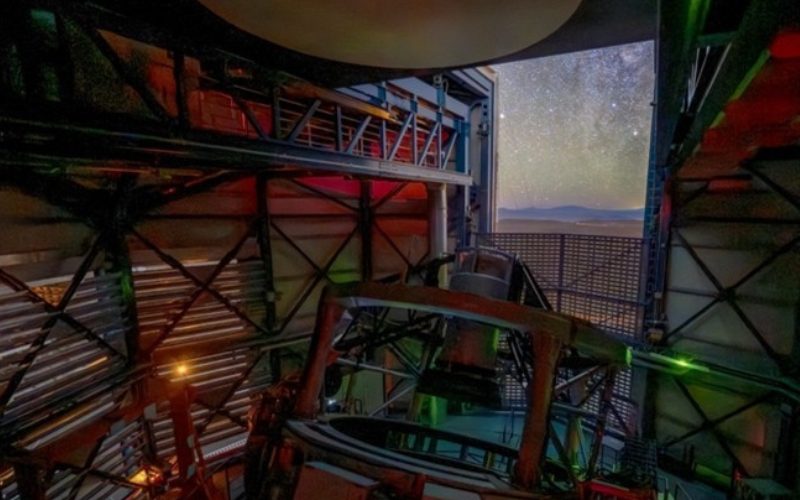
The start of the 4MOST surveys follows an extensive period of testing and science verification. Over the last year, several observing campaigns have been carried out with 4MOST on the VISTA telescope in Chile to ensure that the instrument and the scientific infrastructure are ready for the full survey programme. With the start of the ambitious five-year survey programme, 4MOST enters its main scientific phase, providing new insights into the Milky Way, its neighbouring galaxies and galaxy evolution across the Universe.
Text adapted from AIP release.
Image gallery